
7 Signs It May Be Time to Sell Your West Hartford CT Rental Property
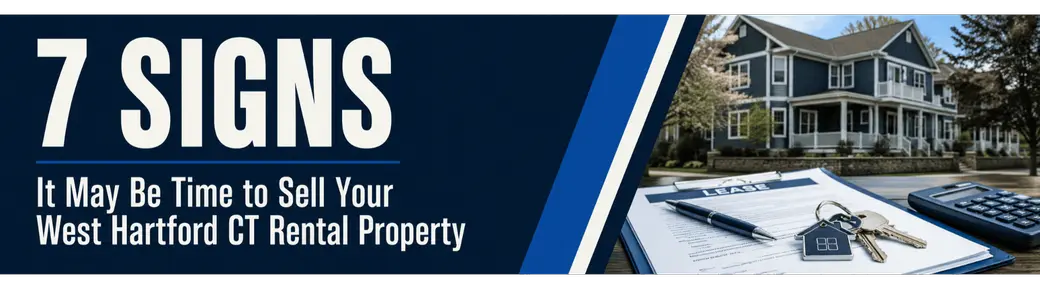
7 Signs It May Be Time to Sell Your West Hartford CT Rental Property
It is 9:00 on a Friday night.
Your tenant texts to say there has been no hot water all day. You are three states away at a wedding, dressed up and holding a drink you can no longer enjoy.
You have a reliable contractor—but it is late, it is the weekend and getting someone there will cost more. Now you are coordinating an emergency repair while everyone around you is celebrating.
That is the part of being a landlord people warn you about. It does not fully register until the interruption belongs to you.
I have been a landlord. I am glad I did it, and I expect I will own rental property again. Real estate can be an important part of a long-term financial plan.
But being a landlord is not right for everyone, and it may not be right for every season of your life.
The decision to sell should not be based on one frustrating repair call. It also should not be based on loyalty to a house or the belief that real estate should always be held forever.
A rental is an investment. The better question is whether it is still doing the job you need it to do.
Here are seven signs that it may be time to sell a rental property in West Hartford, Connecticut or the surrounding Greater Hartford area.
1. The rent no longer covers the real cost
Many landlords compare the monthly rent with the mortgage payment and conclude that the property is profitable.
That calculation leaves too much out.
Include property taxes, landlord insurance, utilities paid by the owner, landscaping, snow removal, repairs, vacancy, turnover, leasing expenses and professional fees. Your tax returns can help you reconstruct what the property earned and cost. IRS Publication 527 addresses rental income, expenses and depreciation, although your CPA should interpret how those items apply to you.
Do not forget the major repair paid from savings or the vacant month between tenants. Include the time you spend coordinating contractors and answering messages.
If the result is thin or negative, the tenant may not be supporting the property as much as you thought.
You may be supporting it.
2. You have substantial equity producing a weak return
A rental can have positive cash flow and still be an inefficient use of your equity.
Suppose selling would leave you with approximately $200,000 after the mortgage and selling expenses. If the property produces $8,000 in true annual profit, your cash return on that available equity is about 4%.
That does not automatically mean you should sell. Appreciation, mortgage reduction and tax treatment can add to your total return.
It does mean you should ask:
What is this equity earning, and what else could it do for me?
You may prefer the long-term potential of real estate. You may also decide that the money could reduce debt, fund retirement or purchase a better-performing investment.
Equity is valuable, but it is not automatically productive simply because it remains inside a house.
3. The current West Hartford CT market gives you an opportunity
No one can identify the perfect moment to sell or guarantee what the market will do next year.
We can still read the current conditions.
At the time of writing in summer 2026, recent public data continued to describe West Hartford as competitive. Redfin reported that homes sold in about 20 days over the three months ending in May 2026. Realtor.com reported a 12-day median market time in June 2026 and characterized the town as a seller’s market. The sources use different time periods and methods, but both indicate continued buyer demand.
That matters if you own a rental in West Hartford, Simsbury, Farmington, Newington or another desirable Central Connecticut community.
A strong market does not mean every rental will sell immediately or above asking. Tenant status, condition, price and property type all affect the strategy.
It does mean that today’s market value deserves to be calculated before you hold automatically.
4. You have stopped wanting the landlord job
A spreadsheet cannot measure the stress of a late-night repair, difficult turnover or tenant who stops paying.
Being a landlord involves screening, leases, maintenance, bookkeeping, communication and compliance. Even when the property performs well, it remains a business.
Ask yourself:
Do I still want to operate this business, or am I holding the property out of habit?
Some owners enjoy managing rentals and have reliable systems. Others feel dread every time the tenant’s name appears on the phone.
That response does not make you a bad landlord. It may mean the property no longer fits your time, risk tolerance or priorities.
5. Your life has moved on
Perhaps you moved away from Connecticut and remote management is harder than expected. You may be approaching retirement and would prefer a lump sum to another part-time responsibility.
You may have inherited the property and never intended to become a landlord. Or you may need the equity for paying off debt, helping a child or beginning a new chapter.
Picture where you expect to be five years from now.
Does this property help you get there?
A good investment should support your plan. You should not have to keep designing your life around a property merely because you already own it.
6. A major repair cycle is approaching
Look at the property without minimizing what is coming.
How old are the roof, heating system, water heater and windows? Will the kitchen or bathrooms require work to remain competitive? Are there electrical, plumbing or drainage concerns you have postponed?
One major repair does not automatically justify selling. The warning sign appears when several costly projects are approaching and the property’s return is already weak.
A new roof may protect value, but it does not necessarily increase the selling price dollar for dollar. You could invest heavily to continue renting and then face an unrelated life change that requires you to sell shortly afterward.
Before spending $30,000 or $50,000, compare three choices: complete the work and keep renting, complete selective work and sell, or sell in the present condition.
7. A tax-planning window may be open
Taxes should not be an afterthought.
A property that was previously your primary residence may qualify for some home-sale gain exclusion when the ownership and use requirements are met. In general, the IRS requires ownership and use as a main home for at least two of the five years ending on the sale date. The potential exclusion is up to $250,000 for qualifying single filers and up to $500,000 for qualifying married couples filing jointly.
Rental use complicates the calculation. Depreciation allowed or allowable during the rental period generally cannot be excluded and can affect taxable gain.
A Section 1031 like-kind exchange may be another possibility when qualifying investment real estate is exchanged for other qualifying real property. It defers qualifying gain rather than eliminating it and involves strict requirements and deadlines.
I am not a tax adviser. Speak with a CPA, tax attorney and, when appropriate, a qualified 1031 intermediary before listing or accepting an offer.
The important point is timing. A tax opportunity can be worth more than another year of rent.
The two numbers that clarify the decision
You do not need all seven signs to apply.
When three or four point in the same direction, the property deserves a serious review.
Start with two numbers:
What would the rental realistically sell for in today’s market?
What is it truly earning after every expense?
The first requires a property-specific market analysis—not an automated estimate.
The second requires honest accounting. Include vacancy, repairs, reserves and the value of your time.
Then place those numbers beside your five-year plan.
The answer may be to sell. It may be to hire professional management, complete repairs or hold longer.
My job is not to convince every West Hartford CT landlord to sell. It is to close the gap between what the investment feels like it is doing and what the numbers show it is doing.
When you know the current market value and the true return, you can decide from a position of clarity rather than waiting for the next 9:00 p.m. text to decide for you.
Jessica Beganski is a Connecticut Realtor® serving West Hartford, the Farmington Valley, and Greater Hartford with more than 20 years of real estate experience. She helps buyers make informed decisions by combining local market expertise with practical guidance tailored to each client's goals. This article provides general information and should not be considered legal, tax, lending, or financial advice.
Categories
Recent Posts







GET MORE INFORMATION