
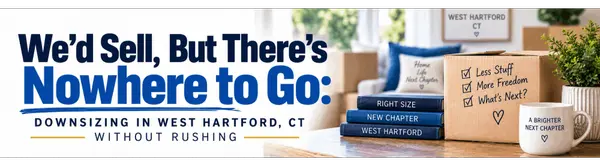
4 Downsizing Options for West Hartford, CT Area Homeowners

4 Downsizing Options for West Hartford, CT Area Homeowners
Many homeowners in West Hartford, Connecticut, are not opposed to selling.
They are opposed to selling without knowing where they will go next.
The concern is understandable. You may have a comfortable home in a neighborhood you know, possibly with a paid-off mortgage or a manageable payment.
Why give that up for a property that might not be as nice?
Why sell before you know you can find a suitable replacement?
And what happens if you put your home on the market, receive an offer, and still have nowhere to move?
Those are not reasons to avoid exploring your options. They are reasons to create a better plan.
Downsizing does not have to mean making a rushed purchase or moving into a home you do not like. There are several possible paths in and around West Hartford, CT, and each offers a different balance of ownership, flexibility, maintenance, and lifestyle.
Here are four options to consider.
Option 1: Rent after selling your West Hartford, CT home
Renting is often dismissed by longtime homeowners because it can feel like a step backward.
It does not have to be.
A rental can be a temporary bridge between selling your current home and purchasing the next one. It can also become a long-term choice for someone who no longer wants the responsibilities of homeownership.
Why renting may work
The greatest advantage is flexibility.
Selling first may allow you to access the equity in your current home and approach the next purchase without needing to coordinate two transactions perfectly.
You can move into a rental, take your time, and wait for a property that genuinely fits your needs.
You are not forced to purchase the first acceptable home simply because your sale is closing.
Some newer apartment communities near West Hartford offer features that may be more functional than an older single-family home, including:
- Elevators
- Single-level living
- Fitness facilities
- Pools and shared outdoor spaces
- Pet-friendly policies
- On-site maintenance
- Locations near restaurants, parks, and shopping
Renting can also reduce the number of household tasks competing for your attention. You are no longer responsible for replacing the roof, repairing the driveway, mowing the lawn, or arranging snow removal.
What to consider before renting
The financial tradeoff is that your monthly payments do not build equity in a property you own.
Rents may also increase, and you may have less control over renovations, pets, parking, and how long you can remain in the unit.
Before choosing a rental, review:
- The lease term
- Renewal and rent-increase policies
- Parking and storage
- Pet restrictions
- Accessibility
- Guest accommodations
- Which utilities are included
- The distance from family and regular activities
Renting may be a good fit when:
- You want to sell before purchasing.
- You need access to your home equity.
- You are unsure which community you want to live in next.
- You want significantly less maintenance.
- You value flexibility more than continued ownership.
Renting does not need to be permanent. It can simply create room to make a thoughtful decision.
Option 2: Purchase a condominium
A condominium can provide a middle ground between renting and owning a single-family home.
You continue to own your residence and may benefit from future appreciation, but the association handles some exterior responsibilities.
Depending on the development, the association may manage:
- Lawn care
- Landscaping
- Snow removal
- Trash service
- Exterior maintenance
- Common areas
- Community amenities
For a homeowner who wants less physical work without giving up ownership, that can be appealing.
Why a condo may work
Condominiums come in many forms.
You may find a traditional apartment-style unit with an elevator, an attached townhouse, a detached condominium, or a home in a 55-plus community.
Some offer primary bedrooms on the main floor, attached garages, guest bedrooms, and finished lower levels.
This means downsizing into a condo does not necessarily mean living in a small apartment or giving up privacy.
What to consider before buying a condo
The association needs to be evaluated as carefully as the individual property.
Monthly fees can cover valuable services, but they become part of your ongoing housing cost. Fees can increase, and owners may be responsible for special assessments when major work is required.
Before purchasing, review:
- The current monthly fee
- What the fee includes
- Recent fee increases
- Reserve funds
- Pending or recent special assessments
- Association meeting minutes
- Rules affecting pets, rentals, and renovations
- Age restrictions
- Parking and guest parking
- Responsibility for windows, doors, roofs, and mechanical systems
You should also consider how much interior maintenance remains your responsibility. A condominium reduces certain tasks, but you may still be responsible for plumbing, heating, cooling, appliances, and interior repairs.
A condominium may be a good fit when:
- You want to continue owning.
- You want exterior maintenance handled for you.
- You are comfortable following association rules.
- You want access to amenities or a shared community.
- You are prepared to include association fees in your long-term budget.
Do not judge a condominium only by its purchase price. Compare the total monthly expenses with the association’s financial health.
Option 3: Buy a smaller home with guest space
Some homeowners do not want a condominium, apartment, or an age-restricted community.
They want to continue owning a traditional home—just one that fits their current life better.
A smaller single-family home with a guest suite, finished lower level, or a flexible bonus room can provide a useful compromise.
Your everyday living space can be more manageable while you retain room for adult children, grandchildren or out-of-town guests.
Why a smaller home with guest space may work
This option can provide:
- Continued ownership and privacy
- A traditional neighborhood setting
- Separate space for overnight guests
- Fewer unused rooms
- Lower maintenance than a larger property
- The ability to remain near West Hartford, Greater Hartford or the Farmington Valley
Some homeowners hope to sell a larger, paid-off home and purchase a smaller property without taking on a new mortgage.
Whether that is realistic depends on your current home’s value, the cost of the replacement property, selling expenses and any improvements the new home may require.
The goal should be to compare actual net proceeds and total costs rather than assuming a smaller home will automatically be less expensive.
What to consider before buying another house
A smaller single-family home is still a house.
You remain responsible for:
- Property taxes
- Insurance
- Heating and cooling
- Yardwork
- Snow removal
- Repairs
- Exterior maintenance
- Future updates
Pay close attention to the layout.
A home may have fewer square feet but still include steep stairs, a difficult driveway or laundry in the basement. Those features may not solve the problem you are trying to address.
Also consider how often the guest space will actually be used.
You may not need several dedicated bedrooms throughout the year. A finished lower level, office with a sleeper sofa or flexible den may provide enough space without recreating the same excess capacity you are leaving behind.
A smaller home with guest space may be a good fit when:
- You want to remain in a traditional neighborhood.
- You are not ready for condominium living.
- You want privacy and control over the property.
- You need occasional space for family.
- You are willing to continue handling some maintenance.
The best replacement home is not simply a smaller version of your current house. It should solve the specific issues that are leading you to consider moving.
Option 4: Purchase a ranch or one-level home
Not everyone who considers downsizing wants less space.
Some homeowners mainly want a better layout.
You may want to keep a comfortable living room, guest bedrooms, and an attached garage while eliminating the stairs that could become difficult later.
A ranch can provide that.
Why a ranch may work
A true ranch places the primary living areas on one floor.
That can make daily life easier now while also preparing for possible mobility changes in the future.
You may be able to remain in a similar neighborhood and retain many of the features you enjoy of single-family homeownership.
A ranch can offer:
- One-level daily living
- Continued ownership
- Private outdoor space
- An attached garage
- Room for guests
- A familiar neighborhood lifestyle
For some homeowners, this is less of a traditional downsize and more of a strategic change in layout.
What to consider before buying a ranch
Ranch homes often attract significant buyer interest in West Hartford, CT, and the surrounding communities.
Many buyers want one-level living, including first-time buyers, families, downsizers, and people planning for future accessibility. That can make well-located ranches competitive.
A ranch is also not maintenance-free.
You will still be responsible for the lawn, driveway, roof, mechanical systems, taxes, and repairs. A sprawling ranch can also have a large roof and exterior footprint, even when everything is on one floor.
Some newer one-level homes are located in planned or 55-plus communities. Those properties may combine the privacy of a detached home with association fees and community rules.
Review those fees and responsibilities carefully.
A ranch may be a good fit when:
- Stairs are your primary concern.
- You want to retain a similar amount of living space.
- You prefer a single-family home.
- You are prepared to compete for the right property.
- You are willing to continue maintaining a home and yard.
How to compare the four options
Do not begin by asking which option is universally best.
Ask which tradeoffs are acceptable to you.
Compare the total monthly cost.
Include more than the purchase price or rent.
Review:
- Mortgage payment, when applicable
- Property taxes
- Homeowners or renters insurance
- Condominium or association fees
- Utilities
- Maintenance
- Repairs
- Parking
- Storage
- Transportation costs
A lower-priced property with high fees may end up costing more each month than expected. A rental with several services included may be more competitive than it first appears.
Compare the work required
Be specific about what you want to stop doing.
Do you want to eliminate:
- Lawn care?
- Snow removal?
- Exterior repairs?
- Stairs?
- Managing contractors?
- Cleaning unused rooms?
- Worrying about the house while traveling?
A property should reduce the responsibilities that are actually affecting your life.
Compare the location
A less expensive home may not feel like an improvement if it takes you away from family, healthcare, friends, and the activities you enjoy.
Consider the distance to:
- Children and grandchildren
- Doctors and medical facilities
- Grocery stores
- Restaurants
- Parks
- Cultural activities
- Your place of worship
- Public transportation
- Major highways
Location often matters more after a move, not less.
Compare your need for guest space
Be honest about how often guests stay overnight.
You may need a full guest suite—or only a flexible room, a few weekends each year.
Do not pay for and maintain significant extra space unless it supports how you actually live.
Compare your need for control
Some people value the freedom to renovate, garden, and make decisions about their property.
Others are ready to give up some control in exchange for fewer responsibilities.
Neither preference is wrong. But it will influence whether renting, a condominium, or another single-family home feels comfortable.
You do not have to sell before you understand the options
The fear of having nowhere to go usually becomes more manageable once you replace assumptions with information.
Before listing your West Hartford, CT home, you can:
- Estimate its current market value.
- Calculate your likely net proceeds.
- Identify your preferred monthly housing budget.
- Tour several different types of homes.
- Compare ownership and rental costs.
- Determine whether you need to buy before selling or sell before buying.
- Create a backup plan in case the timing does not align perfectly.
Depending on your circumstances, your sale strategy may include negotiating a flexible closing date, requesting time to remain in the home after closing, or arranging a temporary rental.
Those options depend on the market, the buyer, and the terms of the transaction. They should be planned before the property is listed—not after you accept an offer.
The goal is not to make your life smaller
Downsizing is often described as giving something up.
A better goal is to create a home that requires less from you and gives you more freedom in return.
That may mean renting in a walkable location, purchasing a condominium, finding a smaller home with guest space, or competing for a one-level ranch.
There is no single correct answer.
The best West Hartford, CT downsizing option is the one that fits your finances, preferred lifestyle, family needs, and tolerance for maintenance.
You do not need to make the decision today.
But you can begin to understand the choices while you still have time to decide on your own terms.
My Downsizing Timeline can help you organize the process, including what to sort first, what to address next, and how to spread the work out over time.
When you are ready, we can also compare what your current home may sell for with realistic housing options in West Hartford, Greater Hartford, and the Farmington Valley.
Jessica Beganski is a West Hartford, Connecticut, Realtor and listing agent with eXp Realty. She helps homeowners whose homes no longer fit the way they want to live prepare, price, and sell their homes, and plan what comes next. Jessica works with sellers throughout West Hartford, the Farmington Valley, and Greater Hartford, with particular experience in downsizing, older and long-held homes, inherited properties, relocation, and coordinating a home sale with the next move. This article provides general information and should not be considered legal, tax, lending, or financial advice.
Categories
Recent Posts






GET MORE INFORMATION