
More Homes Are for Sale in West Hartford CT—Are Sellers Losing Their Advantage?
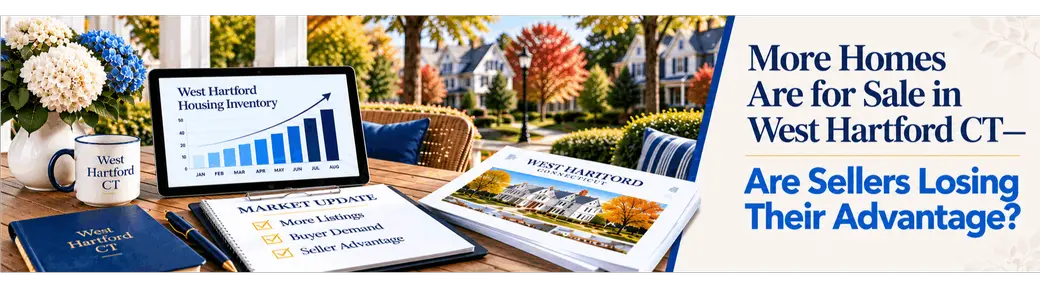
More Homes Are for Sale in West Hartford CT—Are Sellers Losing Their Advantage?
Market statistics in this article reflect West Hartford and Hartford County data through July 2026.
If you have been thinking about selling your West Hartford, Connecticut home, you may have noticed more For Sale signs around town this year.
That can create a reasonable question:
Is the West Hartford housing market starting to slow down?
Maybe you have been waiting for fall. Maybe you assumed spring would be better. Or perhaps you know a move is somewhere in your future, but you are worried that you missed the strongest seller’s market.
More homes did come on the market in West Hartford this year.
But that is only half the story.
The more important question is what happened after those homes were listed.
Buyers bought them.
Through July 2026, West Hartford single-family listings were up almost 12% compared with the same period last year. At the same time, pending sales increased approximately 9.5%, and closed sales were up about 7%.
That matters because more inventory alone does not create a slower market.
A market begins to shift when supply grows faster than buyer demand can absorb it. That is when homes generally begin sitting longer, sellers make more price reductions, and the percentage of asking price buyers are willing to pay starts falling.
So far, that is not what the West Hartford CT numbers are showing.
More West Hartford homes came on the market—and buyers absorbed them
If buyer demand were weakening, I would expect days on market to increase noticeably.
Year-to-date, the median market time for West Hartford single-family homes increased by only one day, from 13 to 14 days.
When you compare July 2026 directly with July 2025, there was no change at all. The median was 11 days in both periods.
The percentage of asking price sellers received also remained strong.
Year to date, West Hartford single-family homes averaged approximately 109.8% of asking price, up slightly from 109.2% during the comparable period last year.
In July alone, sellers averaged approximately 112% of asking price.
That does not mean you should list your home at any price and expect buyers to bid it up. The homes that generate competition are generally the ones buyers perceive as appropriately priced for their condition, location, and competition.
But it does tell us something important.
The additional inventory has not yet caused West Hartford buyers to pull back.
Do not let one home-price statistic make the decision for you
The July median single-family sale price in West Hartford was approximately $635,000, more than 20% higher than the previous July.
That sounds dramatic.
It also requires context.
A monthly median reflects the particular group of homes that happened to close during that month. If more higher-priced properties sell in one July than another, the median can increase substantially without every individual West Hartford home gaining 20% in value.
The year-to-date number is more useful.
Through July 2026, the West Hartford median single-family sale price was approximately $577,500 compared with $547,500 during the comparable period last year, an increase of roughly 5.5%.
That is still a meaningful increase.
It is simply a more reasonable way to describe what is happening than telling every homeowner their property has suddenly gained 20%.
I would rather give you a useful number than a sensational one.
Your home’s value ultimately depends on your neighborhood, price range, condition, improvements, lot, and the competing properties available when you decide to sell.
I look for signs of a slowdown before prices fall
Home prices are often one of the last indicators to change.
When sellers put homes on the market, and buyers do not respond as expected, something usually happens first.
The seller reduces the price.
The property sits longer.
Or the seller gives up and takes it off the market.
That is why I pay attention to price reductions, expired and canceled listings, days on market, and months of inventory.
Through July, the share of Hartford County listings requiring price reductions was essentially unchanged from the previous year.
Expired and canceled listings were also relatively flat.
Hartford County had approximately 1.9 months of housing supply.
And sellers countywide averaged about 106% of asking price in July.
Those are not the statistics I would expect to see if buyers had suddenly gained control of the market.
Why are Hartford County sales down?
This is a good example of why headlines need context.
Hartford County pending and closed sales were down year to date.
It would be easy to interpret that as falling buyer demand.
But new listings were down too.
Fewer homes were selling because fewer homeowners were putting homes up for sale.
That is different from having plenty of homes available and no one wanting to buy them.
Year to date, Hartford County sellers received approximately the same percentage of asking price they received during the comparable period last year.
If buyer demand were disappearing, I would expect sellers to be receiving less.
Instead, the larger Greater Hartford market continues to have a supply problem.
West Hartford remains stronger than many surrounding markets
The differences become clearer when you compare towns.
In July 2026, West Hartford single-family sellers averaged approximately 112.1% of asking price with a median of 11 days on market.
Hartford County overall was closer to 106.2% of asking and 15 days.
Simsbury was also very competitive, averaging approximately 110% of asking with only seven days on market.
Newington came in around 108.6%, while Farmington and Avon were closer to 105%.
Every single-family market I was tracking sold at or above asking price on average in July.
The exact numbers vary by town, but the broader message is that Greater Hartford and the Farmington Valley have not followed every national housing headline you may be seeing.
Real estate is local.
And sometimes it is very local.
What is happening in West Hartford may be different from Farmington. What is happening with a $450,000 Colonial may be different from an $850,000 property a few streets away.
That is why your decision should start with your house rather than a national headline.
Condos are giving us a different signal
Not every part of the West Hartford, CT market is behaving the same way.
Condos deserve their own conversation.
West Hartford condo contracts were actually up year-to-date through July, and condos were selling slightly faster than during the comparable period last year.
What changed was seller leverage.
The average list-to-sale price ratio for West Hartford condos fell from approximately 104% of asking last year to about 101.5% year to date.
In July alone, condos averaged approximately 99.6% of asking price.
That caught my attention because West Hartford condos had been consistently averaging above asking.
Why the shift?
Supply.
West Hartford had significantly more condo listings come on the market in July than it did one year earlier.
When buyers have more options, they do not have to compete quite as aggressively for each one.
I do not know yet whether that will become a long-term trend. One month does not establish a new market.
But it is something worth watching, particularly if you are thinking about selling a single-family home and purchasing a condo.
So should you sell your West Hartford, CT home now?
Here is what the July numbers tell me.
More West Hartford homeowners decided to sell, and buyers continued absorbing the inventory.
Homes did not suddenly begin sitting.
Sellers did not begin accepting significantly lower percentages of asking price.
Price reductions did not surge.
Unsuccessful listings did not meaningfully increase.
There is nothing in those numbers telling me that West Hartford single-family sellers suddenly lost their leverage.
But that does not mean I think you should sell simply because the market is good.
The market can change.
No one can reliably identify the absolute top, and trying to time it perfectly can keep you stuck for years.
Your life should make this decision.
The market tells you what conditions exist when you are ready.
If the house has become too large, you want to be closer to family, your commute has changed, you are planning for retirement or you simply want a different lifestyle, today's market may give you a favorable opportunity to make that move.
If you love the home and it still fits your life, a strong market by itself is not a reason to leave.
Before deciding, get the numbers for your house
A market report can tell you what is happening in West Hartford.
It cannot tell you whether you should sell your particular home.
For that, you need to know:
What could your home realistically sell for?
What would you likely net after the mortgage and selling expenses?
What would the next home cost?
How would your monthly expenses change?
Would you need to sell before buying, or could the transactions overlap?
Those answers turn a general question—“Is now a good time to sell?”—into a much more useful one:
“Is this a good time for me to make the move I already know I want to make?”
That is the conversation worth having.
If you are considering selling a home in West Hartford, Connecticut, I can help you look at your house, your likely equity, and your next move together.
Because the market matters.
It just should not be the only thing deciding what happens next.
Jessica Beganski is a Connecticut Realtor® serving West Hartford, the Farmington Valley, and Greater Hartford with more than 20 years of real estate experience. She helps buyers make informed decisions by combining local market expertise with practical guidance tailored to each client's goals. This article provides general information and should not be considered legal, tax, lending, or financial advice.
Categories
Recent Posts








GET MORE INFORMATION