
Why Isn’t My House Selling in West Hartford CT?
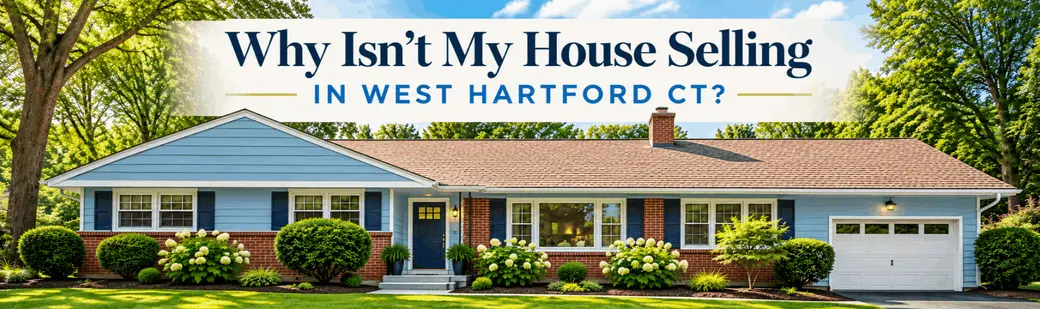
Why Isn’t My House Selling in West Hartford CT?
Your neighbor listed after you and already has a Sold sign in the yard.
Your house has had a few showings, but no offers.
Nobody has said anything particularly terrible about it.
And now your agent has brought up the subject you do not really want to discuss:
A price reduction.
Maybe you think the staging needs work.
Maybe the photos are not good enough.
Maybe the marketing is the problem.
Maybe you hired the wrong agent.
Any of those things could be contributing.
But if your home has been on the market longer than comparable properties and buyers are not responding, the first place I would look is the price.
I know that may not be what you want to hear.
It also does not mean your house is bad or that you made a terrible decision when you listed it.
It means the market is giving you information.
The sooner you understand what that information is saying, the more options you still have.
Start with what your listing is already telling you
When a home does not sell, sellers sometimes wait for one dramatic piece of feedback.
“The kitchen is too dated.”
“The yard is too small.”
“The road is too busy.”
But often the most useful feedback is buyer behavior.
Are they scheduling showings?
Are they coming but not offering?
Are they making offers well below your asking price?
Are similar properties going under contract while yours continues to sit?
Those patterns tell us more than one buyer’s comment after a showing.
Here are four signals I pay attention to.
1. You are getting very few—or no—showings
If buyers are not even coming through the door, something is stopping them before they experience the house.
That can be poor photography or weak marketing.
But most often, it is price.
Suppose you own a 2,500-square-foot Colonial and list it at $800,000 in a neighborhood where comparable homes do not support that number.
The buyer specifically looking in your neighborhood may decide the property is too expensive.
Meanwhile, the buyer comfortable spending $800,000 may be comparing your home with properties in other areas that offer newer kitchens, larger lots or more updates.
Your house was not necessarily rejected after a showing.
It may never have made the buyer’s list.
That distinction matters.
You cannot negotiate with buyers who never decide to see the property.
2. You are getting showings but no offers
This tells me something different.
Your marketing and price were good enough to get buyers through the door.
Then they saw the property and decided another home offered better value.
Maybe the objection is the condition.
Maybe it is the floor plan.
Maybe it is the road, lot, garage or updates.
But buyers usually add three unspoken words to those objections:
For the price.
A dated kitchen is not automatically a dealbreaker.
A small yard is not automatically a dealbreaker.
A busy road is not automatically a dealbreaker.
Buyers accept compromises every day when the overall package makes sense.
If they repeatedly tour the house but choose something else, the question is not simply what they disliked.
It is whether the asking price properly compensates for the thing they disliked.
3. Your home is well beyond the normal market time
One extra week does not automatically mean you have a problem.
Different neighborhoods, property types and price ranges behave differently.
But if similar West Hartford CT homes are going under contract and yours is still available, pay attention.
The comparison should not be against every property in town.
Your agent should be watching the houses that compete directly with yours.
If three comparable homes have listed after yours and already gone under contract, simply saying “give it more time” is not much of a strategy.
Ask:
What exactly are we waiting for?
More time does not change your kitchen.
It does not change the road.
It does not improve the photos.
And it does not automatically create a buyer willing to pay more.
Sometimes time is appropriate.
Sometimes it simply increases your days on market without solving the underlying problem.
4. You are getting offers, but they are consistently lower than expected
One low offer is one buyer’s opinion.
Several serious buyers landing around the same number is market information.
You may not like the information.
You should still pay attention to it.
If one buyer offers $575,000 on a $625,000 listing, that buyer may simply be testing you.
If three unrelated buyers are all somewhere around $580,000 to $590,000, the market may be showing you a range.
The next offer is not automatically going to be higher.
It may just take longer to arrive.
How does a house become overpriced in the first place?
Most sellers do not intentionally choose an unrealistic number.
The price often makes sense to them when they list.
Maybe you chose the agent who gave you the highest opinion of value.
If two agents said your home was worth around $525,000 and another said $575,000, it is understandable which number you wanted to believe.
But an agent can say any number.
Eventually, a buyer has to be willing to pay it. If the buyer is financing, an appraiser also needs to support the sale.
When interviewing an agent, do not ask only:
“What do you think my house is worth?”
Ask:
“Show me how you got to that number.”
You need the reasoning, not simply the most flattering answer.
What you need is not the same as what the house is worth
You may need a certain amount because of the mortgage balance or the house you plan to buy next.
That number absolutely matters to your move.
It does not determine market value.
Buyers do not know what you need to walk away with, and they are not basing their decision on it.
They are comparing your home with everything else their money can buy.
That is why the selling strategy has to begin with the market and then determine whether the move works financially—not the other way around.
Be careful pricing from an automated estimate
Online estimates can be a useful reference point.
They are not a substitute for walking through the property.
An algorithm cannot fully understand how your addition functions, whether your renovations feel current, whether the floor plan is awkward or how your home compares emotionally with another property on the same street.
It sees data.
A buyer sees a house.
Use online estimates as one piece of information, not as your entire pricing strategy.
Your neighbor’s sale matters—but it is not your house
Your neighbor’s sale absolutely belongs in the conversation.
But we also need to compare condition, updates, location, lot, layout and competing properties.
Maybe their house had a two-car garage and yours has one.
Maybe your kitchen is substantially better.
Maybe their yard was flat and yours is steep.
A single nearby sale cannot answer all of those questions.
Can you fix anything before reducing the price?
Sometimes.
But I want to make an important distinction.
If the house is materially overpriced, better photographs are not going to make the price right.
However, you may have both a pricing problem and a presentation problem.
Addressing both at the same time can give the listing a stronger reset.
Look at:
- Photography
- Floor plans
- Curb appeal
- Cleaning and decluttering
- Lighting
- Minor repairs
- Showing restrictions
- Pet arrangements
- Temperature and comfort during showings
- How the listing is marketed after launch
Photos should sell the experience of the home, not merely document every room.
A floor plan can be particularly useful with older West Hartford homes or properties where the layout is difficult to understand from photographs.
If the lot or location is a major strength, aerial photography may help communicate something standard interior photos cannot.
And make sure the home is easy to see.
Requiring excessive notice or severely limiting appointment times reduces the buyer pool before price even enters the conversation.
Your agent should still be managing the listing after day one
Putting the home in the MLS is the beginning of the job.
Your agent should continue tracking competing listings, new sales, showing activity and feedback.
If a similar property comes on two streets away at a lower price, that matters.
If comparable homes keep selling and yours does not, that matters.
If 15 buyers make the same objection, that matters.
The strategy should change as new information becomes available.
You do not need an agent who panics because the house did not sell in four days.
You do need one who is paying attention when the evidence says the original strategy is not working.
What if the problem cannot be fixed?
Then price becomes even more important.
You cannot move a busy road.
You cannot easily redesign an entire floor plan.
There may be no realistic way to add the garage buyers would prefer.
That does not mean the property cannot sell.
It means the price needs to make the compromise reasonable to the right buyer.
The question becomes:
Is this something we should fix—or something we need to price for?
That is an important distinction.
If you reduce, make the change meaningful
Several small price reductions can leave you chasing the market.
A meaningful reduction should move the home into a range where a different or larger pool of buyers will see it.
At the same time, give buyers another reason to reconsider the property.
Update the photography if needed.
Add a floor plan.
Improve the landscaping.
Clean and declutter.
Complete the repair you skipped.
Loosen showing restrictions.
Improve the marketing.
A price adjustment should feel like a new opportunity—not simply the same listing for $5,000 less.
Waiting is an option. It just is not free.
You can keep the price exactly where it is.
If your home is truly unusual, you have no deadline and the right buyer only comes along occasionally, waiting may make sense.
But waiting comes with mortgage payments, taxes, insurance, utilities and maintenance.
There is also a psychological cost in the market.
A new listing creates curiosity.
A home that has been sitting creates questions.
Buyers begin wondering what is wrong—and that can give them more negotiating confidence, not less.
If your West Hartford CT home is not selling, do not start by blaming the house.
Start by reading the market response.
Then decide what needs to change: the presentation, the access, the marketing, the price—or some combination of all four.
The goal is not simply to keep the listing active.
The goal is to put your home back into a position where buyers see enough value to act.
Jessica Beganski is a Connecticut Realtor® serving West Hartford, the Farmington Valley, and Greater Hartford with more than 20 years of real estate experience. She helps buyers make informed decisions by combining local market expertise with practical guidance tailored to each client's goals. This article provides general information and should not be considered legal, tax, lending, or financial advice.
Categories
Recent Posts









GET MORE INFORMATION
